Ask employees at most mid-sized companies what they think of IT, and you'll often get a sigh. "They never call back." "It's been broken for weeks." "I just fix it myself now." These comments come up whether support is an internal team or an outside managed service provider (MSP).
That perception costs you. Employees who don't trust IT stop reporting problems, build workarounds, buy their own software, and lose hours to issues that should take minutes. Leadership sees the frustration but often can't tell what's actually wrong: is it the people, the process, the tools, or the provider?
The answer matters, because the fix is different for each.
The Usual Symptoms
Poor perception of IT rarely comes from one bad experience. It builds over time from patterns like these:
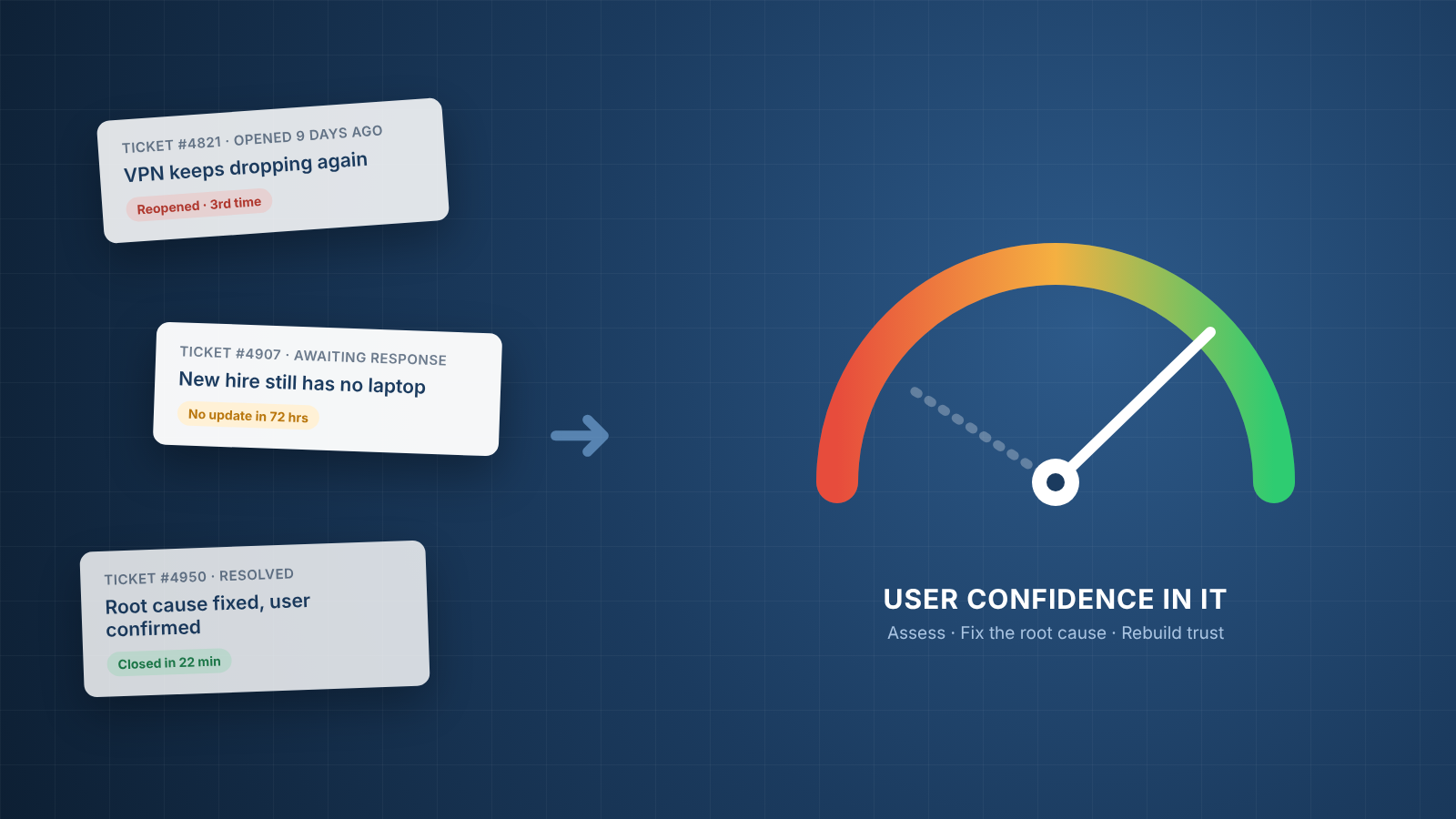
- Tickets disappear. Users submit a request and hear nothing back. No acknowledgment, no timeline, no status update.
- The same problems keep coming back. The VPN drops, someone reboots it, the ticket closes, and next week it drops again. Symptoms get treated; root causes don't.
- Onboarding and offboarding are painful. New hires start without laptops, accounts, or access. Departing employees keep access for weeks.
- Nobody explains anything. IT speaks in jargon, or doesn't speak at all, and users feel talked down to or ignored.
- Response times don't match the business. A down production line or point-of-sale system gets the same priority as a printer toner request.
- Projects drag on. Upgrades and rollouts slip without explanation, and the business stops expecting IT to deliver.
Perception Is a Symptom, Not the Disease
Here's the important part: a bad reputation is usually the visible result of problems underneath. In our experience, those problems fall into a few categories:
- Process gaps. No clear ticket workflow, no priority definitions, no service level expectations, no escalation path.
- Technical debt. Aging hardware, unpatched systems, weak network infrastructure, or poor WiFi coverage generating a constant stream of tickets.
- Staffing mismatches. A small internal team stretched too thin, or a talented team spending all day firefighting instead of improving things.
- Tooling problems. No monitoring, so IT only learns about outages when users complain. No documentation, so every fix starts from scratch.
- Provider fit. An MSP whose model, response times, or attention don't match the size and needs of your business.
- Communication. Good work that nobody sees because users are never told what was fixed, why, or when.
Replacing a provider or reorganizing a team without understanding which of these is driving the problem often just resets the clock on the same frustrations.
How XOR Services Assesses the Situation
XOR Services starts with an objective assessment, not a sales pitch. Using our CADD method (Collect, Analyze, Design, Deliver), we build a clear picture of what's really going on:
- Collect. We interview leadership, IT staff, and end users across departments. We review ticket history, response and resolution times, recurring issues, contracts, and service agreements. We look at the infrastructure itself: network, cabling, WiFi, servers, endpoints, security, and backups.
- Analyze. We separate perception from reality. Sometimes IT is doing solid work that nobody sees. Sometimes the data confirms what users are saying. Usually it's a mix. We identify which root causes drive the most frustration and the most risk.
- Design. We give you a plain-language report with prioritized recommendations, costs, and a realistic timeline, and we review it with you for sign-off before anything moves forward.
- Deliver. You choose the path that fits your business.
Path One: Fix the Underlying Problems
Often the right answer is to keep your current team or MSP and fix what's holding them back. In that case, XOR Services works as a consultant to correct the root causes:
- Define ticket priorities, service levels, and escalation paths that match how your business actually operates
- Put proactive monitoring and patching in place so issues are caught before users notice
- Address infrastructure problems such as network design, structured cabling, and WiFi coverage that generate repeat tickets
- Standardize onboarding and offboarding so new hires are productive on day one
- Build documentation and a knowledge base so fixes stick
- Set up simple, regular communication so users know what IT is doing and why
When the underlying problems are fixed, perception follows. Users notice when tickets get acknowledged, when problems stay fixed, and when someone explains what happened.
Path Two: Replace the MSP and Integrate With Your Staff
Sometimes the assessment shows the current provider isn't the right fit. When that's the case, XOR Services can step in as your managed IT provider.
That doesn't mean pushing your people aside. Many of our clients have internal IT staff who know the business, the users, and the history better than any outside firm. We integrate with them:
- Your staff stays in the loop. We share tools, ticket queues, and documentation so nothing happens in a black box.
- We take on what stretches them thin. Help desk coverage, after-hours monitoring, patching, and escalation support free your team for the projects that move the business forward.
- A planned transition. We handle the handoff from your outgoing provider, including documentation, credentials, licensing, and vendor relationships, so users don't feel a gap in service.
- Predictable cost. Managed IT from XOR Services is delivered under a flat monthly rate, with the scope signed off up front. No surprises.
The result is one support team that combines your staff's knowledge of the business with XOR's depth across infrastructure, support, development, and hosting.
Rebuilding Trust Takes a Plan
Users don't change their opinion of IT because of a memo. They change it when their experience changes: when tickets get answered, problems stay fixed, and IT feels like a partner instead of an obstacle.
Whether you need to strengthen the team you have or bring in a new provider, it starts with understanding what's really driving the frustration.
Is IT a constant source of complaints at your company? Get a consultation with XOR Services, or call us at (980) 785-1999. We'll assess where things stand and give you a clear, signed-off plan to fix it.